
Tip & Trick
Did you know your keyboard hides powerful symbols starting with 'A' that can supercharge your typing speed and productivity? These 10 underused symbols—from accent marks to special characters—are essential for coders, writers, and international communication.
Accented Letters: Á É Í Ó Ú
Spanish, Portuguese, and French typists know the frustration of autocorrect turning "é" into "e" mid-sentence. The Á É Í Ó Ú accented letters aren’t just language flair—they’re essential for accuracy in documents, code comments, and international communication.
On US keyboards, these require Alt+0193 (Á), Alt+0201 (É), Alt+0205 (Í), Alt+0211 (Ó), and Alt+0218 (Ú). For Mac users, press Option + E/I/U before typing the base letter. In programming, they’re critical for variable names like cafémenu or naïvebayes—skipping them risks syntax errors or broken Unicode handling.
If you write in these languages or collaborate with native speakers, mastering these will save hours of edits. They’re also useful for translators, game developers (localization), and anyone drafting multilingual docs. ✨
Angstrom Symbol (Å)
If you’ve ever worked with atomic-scale measurements or Scandinavian text, the Ångström symbol (Å) is your secret weapon. Pronounced "ong-strom," this tiny symbol represents 0.1 nanometers—a critical unit in physics, chemistry, and materials science for describing wavelengths, crystal structures, and even DNA strands.
In Swedish, Norwegian, and Finnish, it’s used in proper nouns (e.g., Åland islands) and technical terms. On Windows, type Alt+0197 for Å, while macOS users can use Option+Shift+A. For engineers, it’s a shortcut to avoid writing out "10⁻¹⁰ meters" repeatedly—saving time in lab reports or patents.
Perfect for researchers, engineers, and even gamers referencing retro tech specs (like CRT resolutions). ⚡
Ampersand (&)
Ever spotted the & in vintage logos or legal jargon? This isn’t just an old-school symbol—it’s the original "and," still powering everything from Team Fortress 2 map names to corporate disclaimers.
Type it directly on your keyboard (Shift+7) or use Alt+0038 for precision. Its unique shape makes it instantly recognizable in branding (think AT&T or & Beyond), while retro gamers rely on it for map references like ctf_2fort. Even in code, it’s used for AND operations in some languages.
Perfect for designers, lawyers, or nostalgic gamers who appreciate a symbol with centuries of history but still relevant today. 💻
Alpha Symbol (α)
Tired of typing out "alpha" every time you need the Greek letter in equations or code? The alpha symbol (α)—Unicode U+03B1—is the fastest way to represent it, whether you're writing LaTeX documents or Python algorithms like α-optimization in machine learning.
You can type it directly using Alt+945 on Windows or Option+A on Mac. In LaTeX, simply use \alpha for seamless integration, while in Python, it’s perfect for variable names like alpha_value or plotting functions. The symbol’s clean, minimalist design also makes it ideal for scientific notation and physics formulas, where clarity matters most.
Perfect for data scientists, engineers, and students—anyone who works with math-heavy fields will appreciate how much faster it is than spelling it out. ⚡
Arrow Symbols: ← →

Need to map out user flows or annotate code logic? The left (←) and right (→) arrow symbols are your secret weapons for clarity. These aren’t just decorative—they’re the backbone of pseudo-code, flowcharts, and UI wireframes, helping you visualize direction without words.
On most keyboards, you’ll find them above the Enter key (←) and on the number pad (→). In programming, they’re used in switch-case statements (if (x > 5) → action) and state machines, while UX designers rely on them to indicate navigation paths in prototypes. For casual users, they’re perfect for quick diagrams in documents or emails.
Whether you’re a developer sketching algorithms or a student organizing notes, these arrows cut through ambiguity. Master them, and you’ll save hours explaining directions. ✨
At Symbol (@)

Tired of typing "at" for every email address? The @ symbol is far more versatile than just separating usernames from domains—it’s the backbone of social media handles, programming decorators, and even email aliases for organizing inboxes.
In coding, it’s a game-changer: Python’s @staticmethod decorator or @property let you define methods without passing self, while JavaScript uses it for object property shorthand ({ name: "@user" }). On social platforms, it’s how you claim your digital identity—Twitter, GitHub, or Reddit all rely on it for uniqueness.
Developers and content creators will love how it streamlines workflows, while casual users might not realize how much cleaner their handles look with a single symbol. Master this one, and you’ll stand out in any digital space. ✨
Asterisk (*)
The **asterisk (*) isn’t just a footnote marker—it’s a Swiss Army knife of symbols that saves time across coding, searches, and even security. From marking required fields in forms to acting as a wildcard in file searches, this tiny character packs a surprising punch.
In programming, it’s a multiplication operator** in languages like Python or JavaScript, while in regex searches, matches zero or more of the preceding character. Password managers often use it to indicate complexity requirements (e.g., "must include "). Even in plain text, it’s the go-to for footnotes or highlighting key terms.
Developers and data analysts will love its versatility, but even casual users can leverage it for quick file searches (e.g., *.txt for all text files) or formatting documents. Mastering this symbol cuts down on repetitive tasks and adds precision to your work. ✨
Alchemical Symbols: Au (Gold)

Diving into history or fantasy? The alchemical symbol for gold (Au) might just be your secret weapon. While it’s not a standard keyboard shortcut, knowing it unlocks precision for chemists, historians, and tabletop RPG enthusiasts alike—especially when documenting ancient manuscripts or treasure maps.
Au (from the Latin aurum) is the official chemical symbol for gold, used in scientific papers, alchemy references, and even D&D character sheets for gold hoards. Typing it manually is simple: hold Alt (Windows) or Option (Mac), then input 0177 on the numeric keypad. For gamers, this avoids awkward workarounds like "gld" or "gold"—just drop Au 500 for a sleek, authentic look.
Perfect for chemistry students labeling lab samples, history buffs transcribing old texts, or DMs who want to sound like a medieval scholar. 💡
Alt Code Shortcut: Alt+0197 (Á)
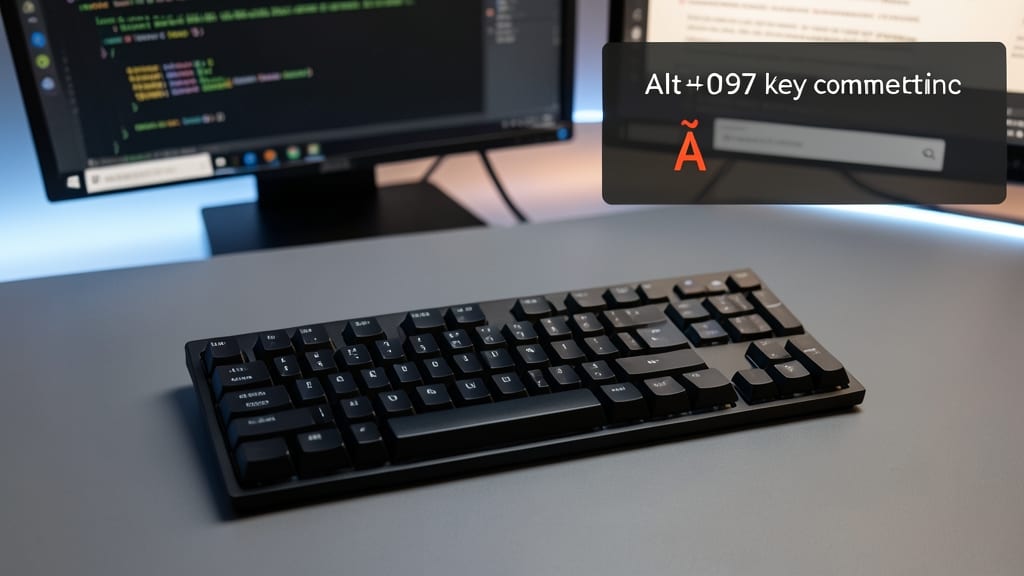
Tired of switching language layouts just to type a simple Á? The Alt+0197 shortcut on Windows and Linux lets you type this accented letter instantly—no language toggle required. This hidden gem works across browsers, documents, and even code editors, making it perfect for bilingual typists or developers working with non-English variable names.
Hold down the Alt key, type 0197 on your numeric keypad, then release both keys to insert Á directly. The same trick works for other accented letters (e.g., Alt+0201 for É). No keyboard remapping or software installs needed—just pure, zero-config efficiency. ⚡
Apostrophe (’)
The tiny apostrophe (’) might look like a simple punctuation mark, but it’s the unsung hero of contractions, possessives, and even programming syntax. Unlike its lookalike, the single quotation mark (‘), it’s the only symbol that can transform "isn’t" into a word or make list’ a valid Python variable name.
In code, the apostrophe helps create variable names with special characters (e.g., file’_backup.py) or string literals in languages like Ruby. For writers, it’s the difference between "John’s book" (correct) and "John’sbook" (confusing). On Windows, press Alt+0146 for the curly apostrophe, while Mac users can use Option+Shift+[ or Option+[.
Developers and copy editors will love this symbol for its precision—no more autocorrect errors or syntax issues. Mastering it ensures your writing and code stay clear, professional, and technically correct. ✨